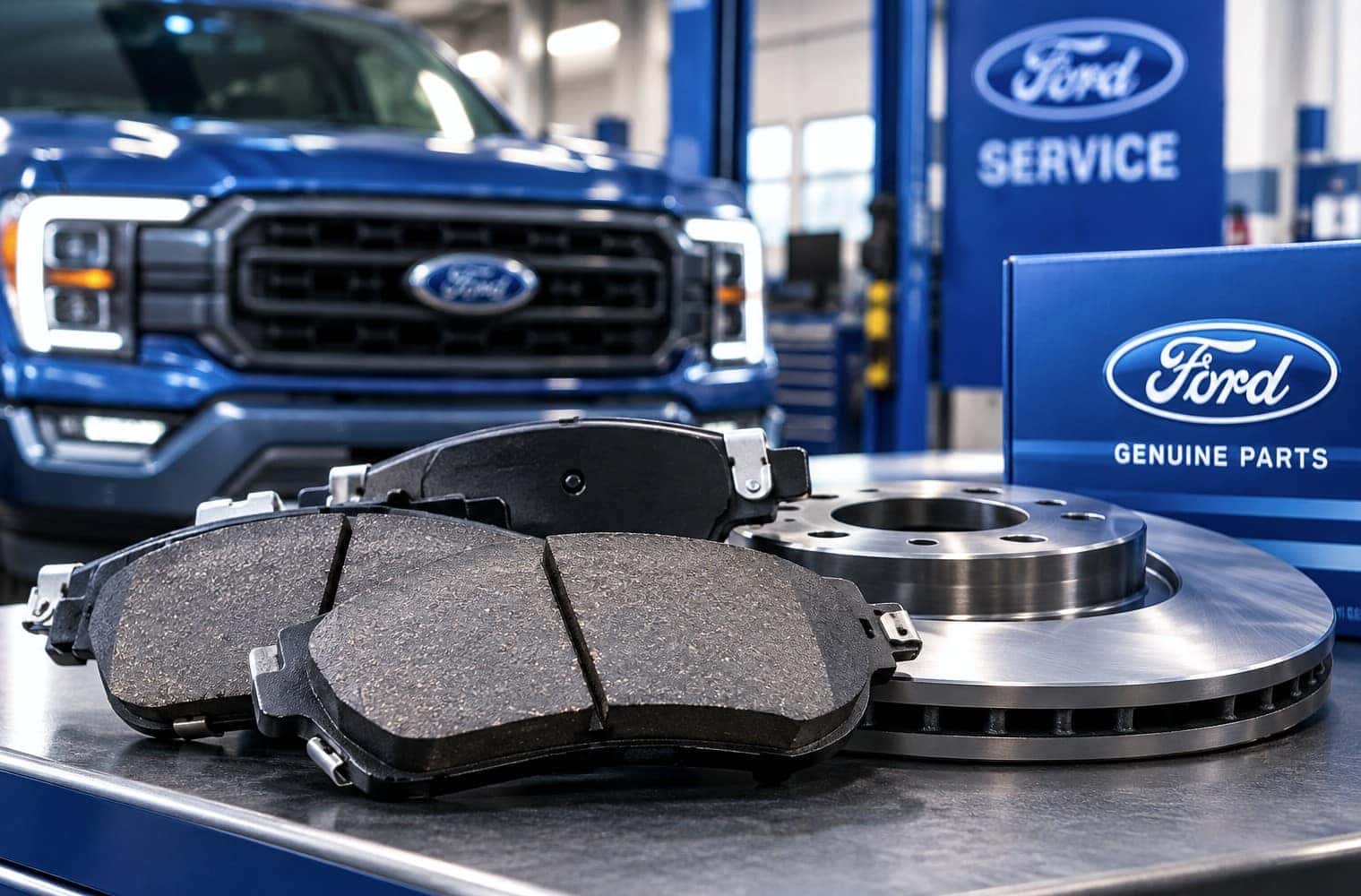
When Should You Replace Ford Brake Pads in St. Louis?
Brake pads do not wear out at one predictable mileage, especially when a Ford regularly encounters St. Louis traffic. For drivers asking, “When should I replace Ford brake pads?”, replacement should be based on measured pad wear, vehicle-specific limits, and changes in braking performance.
This guide explains the mileage ranges, warning signs, inspection points, and driving factors that affect replacement timing.
The Short Answer for St. Louis Ford Drivers
Replace your Ford’s brake pads when they reach the manufacturer-recommended wear limit or develop symptoms that indicate a braking problem. Mileage can help you plan inspections, but it should not be the only reason for replacing pads.
Brake pad replacement is the service performed when the friction material reaches its wear limit or braking symptoms indicate that the pads require attention.
Front brake life ranged from 32,000 to 100,000+ miles across the vehicle categories listed. Actual service life changes with hard braking, stop-and-go city traffic, vehicle gross weight, towing, road conditions, and brake pad material.
A driver who spends most of the week on an open highway may use the brakes less frequently than someone commuting through congested St. Louis streets. Even two identical Ford models can therefore have considerably different brake wear.
Drivers who primarily do open highway cruising may experience slower pad wear because steady-speed travel requires fewer braking events than congested city driving. However, towing, heavy loads, terrain, and frequent hard stops can still shorten brake-pad life.
A soft or spongy brake pedal, unusual noise, or reduced stopping performance should prompt an inspection regardless of mileage. These symptoms may involve more than the pads, so the complete braking system should be evaluated.
Mileage Is a Planning Guide, Not a Deadline
Use 30,000 miles as a reminder to review your Ford’s maintenance history and consider a brake inspection. At 50,000 miles, another inspection is sensible if the pads have not already been replaced, but neither figure is a universal replacement interval.
Reaching the 30,000-mile mark is a good time to review your Ford’s maintenance history and schedule a brake inspection, especially if you drive in stop-and-go traffic, tow, carry heavy loads, or have noticed changes in braking.
Depending on driving conditions, Ford brake pads may last approximately 20,000-60,000 miles, but this range is only a general planning reference. Stop-and-go traffic, frequent hard braking, towing, heavy loads, and pad material can shorten or extend service life, so measured wear and the vehicle’s service specifications should determine replacement.
Repeated braking in city traffic can cause front pads to wear faster than pads used mainly for steady highway cruising. Follow the maintenance and inspection information in your vehicle’s Ford owner’s manual rather than relying on mileage alone.
Signs Your Ford Brake Pads Need Replacement
Grinding, substantially longer stopping distances, a burning odor, or a brake warning light calls for prompt professional assessment. Pulling to one side while braking also requires attention because it can affect vehicle control.
These symptoms do not always mean the brake pads are the only problem. Rotor damage, sticking calipers, hydraulic faults, deteriorated brake lines, and brake fluid problems can produce similar changes.
An anti-lock braking system (ABS) light specifically indicates that the system has detected a fault. It does not confirm worn brake pads by itself, so diagnostic testing is necessary.
Noises, Smells, and Visible Wear
Intermittent squealing can be an early wear indication, although moisture, debris, or pad composition may also cause noise. Persistent grinding noises while braking can mean the friction material has worn away, allowing metal-to-metal contact that may damage the brake rotors.
A brake pad wear indicator is a small metal tab designed to contact the rotor and produce a noticeable squeal as the friction material becomes thin. This sound can signal that the pads should be inspected, although not every Ford uses the same indicator design and other brake conditions can also cause noise.
Pads can also become glazed after excessive heat exposure. Glazing creates a hardened, smooth surface that may reduce friction consistency and change pedal response.
These glazed brake pads have a hardened, shiny friction surface that can reduce consistent braking performance and may contribute to squealing or altered pedal response.
Do not continue driving after noticing a burning smell after braking, particularly if stopping performance has changed or a wheel feels unusually hot. Excessive heat may indicate an overheated brake or a caliper that is not releasing correctly.
Changes in Pedal Feel and Vehicle Control
A soft or spongy brake pedal, longer stopping distances, or pulling during braking should not be treated as normal pad wear. Air in the brake lines, a brake fluid leak, low fluid, or worn brake calipers can cause these symptoms and will not be corrected by replacing pads alone.
If the pedal travels unusually far or braking performance deteriorates suddenly, stop driving when it is safe to do so. NHTSA’s guidance documents may clarify existing legal obligations and are not intended to have the force or effect of law unless expressly authorized by law or incorporated into a contract.
How to Check Brake Pad Thickness Safely
Measuring the remaining friction material is the most direct way to assess brake pad wear. Looking through a wheel opening may offer a partial view, but it rarely provides a reliable assessment of every inner and outer pad on the front and rear brakes.
A measurement near 3 millimeters is commonly treated as a signal to plan replacement soon, but the applicable Ford service specification should guide the decision. It is not a guarantee that driving remains safe because uneven wear, rotor condition, heat damage, and model-specific limits also matter.
When the remaining pad lining is 3 millimeters or lower, immediate replacement is generally appropriate to help prevent the backing plate from contacting and damaging the rotor. Confirm the recommendation against Ford’s service specifications and the condition of the complete braking system.
Compare the inner and outer pad thicknesses on both sides of each axle. A large difference between pads may indicate seized slide pins, restricted movement, or another brake caliper problem.
What an Inspection Should Evaluate
A complete inspection should cover:
- Remaining pad lining thickness on every inspected wheel
- Inner and outer pad wear across each axle
- Brake rotor surface condition and scoring
- Rotor surface conditions, including scoring, cracking, heat spots, and uneven wear
- Minimum rotor thickness
- Caliper operation and slide movement
- Brake fluid level and condition
- Brake lines and hoses
- Brake and ABS warning lights
- These brake system warning lights, including the brake and ABS indicators, should be diagnosed rather than assumed to mean the brake pads are worn.
Rotor condition matters because rotors absorb and dissipate substantial heat during braking. Scoring, overheating, or wear below minimum thickness can affect thermal dissipation and may require rotor resurfacing or replacement where appropriate.
Brake dimensions and service limits differ among Ford models and configurations. Use the vehicle identification details, Ford service specifications, and owner’s manual instead of applying one thickness measurement to every vehicle.
Why Ford Model, Load, and Driving Habits Matter
A commuter vehicle driven gently usually places different demands on its brakes than a truck carrying equipment or operating with a trailer. Frequent heavy loads and repeated hard stops generate more heat, which can accelerate friction-material and rotor wear.
Ford F-150 brake replacement is a useful example because inspection needs can vary with payload, towing frequency, terrain, and vehicle gross weight. A lightly used F-150 may experience a different wear pattern from the same model used daily for contracting work.
On a typical passenger car, the front brakes handle 60 to 70 percent of total braking force because braking shifts weight forward, so front pads typically wear faster than rear pads. Rear pad condition must still be measured because brake balance, design, loading, and component condition influence wear at both axles.
Brake Pad Material Can Change Wear and Feel
Brake pad material affects noise, brake dust, heat tolerance, pedal feel, and wear rate. Common categories include organic brake pads, semi-metallic formulations, and ceramic formulations.
Ceramic pads can provide low dust and long service life under light-to-moderate duty, while semi-metallic or metallic formulations may offer greater heat tolerance for heavy towing or repeated high-load braking.
The right choice depends on the Ford model, braking system, intended use, and applicable specifications. Price alone does not establish whether a pad is suitable for towing, commercial use, commuting, or the vehicle’s original braking design.
What to Do When You Notice a Brake Problem in St. Louis
Arrange an inspection soon if the brakes squeal consistently or measurement shows the pads approaching their wear limit. Seek immediate assessment for grinding, a burning smell, a soft pedal, fluid leakage, pulling, or a substantial increase in stopping distance.
A brake repair service can include pad replacement, rotor inspection, caliper evaluation, or diagnosis of hydraulic and ABS concerns, depending on the inspection findings. Ask for the measured wear and an explanation of which components require attention.
A Ford brake service center can inspect pad thickness, rotor condition, caliper operation, and related brake-system components using the specifications for your model. When choosing where to have the vehicle evaluated, confirm that the facility can document the measured wear and explain whether the recommended work involves pads alone or additional components.
Delaying inspection can allow worn pads to score or overheat the rotors, expanding the repair beyond a pad replacement. A problem with the hydraulic system or calipers may also worsen if its underlying cause remains unaddressed.
For personal and commercial Ford vehicles in the greater St. Louis area, model-specific procedures matter. Technicians should assess the complete braking system and use the correct genuine Ford parts specifications rather than examining the pads in isolation.
Common Mistakes to Avoid
Avoid these common brake-maintenance errors:
- Replacing pads solely because the odometer reached a particular number
- Ignoring severe wear on only one pad or one side of an axle
- Assuming an ABS light automatically means the pads are worn
- Installing new pads without checking rotor surfaces and minimum thickness
- Dismissing vibration when grinding or visible rotor scoring is present
- Topping off low brake fluid without determining why the level dropped
Brake fluid can fall as pads wear because the caliper pistons extend farther, but a low level may also indicate leakage. Identify the cause before adding fluid or replacing components.
Key Takeaway: Replace Pads Based on Wear and Symptoms
Ford brake pads should be replaced when an inspection confirms low friction-material thickness or when braking symptoms reveal a safety or performance concern. Prompt evaluation matters more than reaching a mileage target.
Annual brake inspections are a practical baseline when they align with the vehicle’s maintenance needs. Earlier checks are appropriate for frequent city driving, hard braking, towing, heavy payloads, or any noticeable change in braking.
Frequently Asked Questions
How Long Should Ford Brake Pads Last?
Brake-pad lifespan varies substantially by vehicle and use. The front-brake life span is approximatively from 32,000 to 100,000+ miles among the vehicle types tracked; driving conditions, braking habits, pad material, vehicle load, and the balance between highway and stop-and-go driving can shorten or extend service life.
What Is the 30/30/30 Rule for Brakes?
There is no universal Ford maintenance standard called the 30/30/30 rule. Use the Ford owner’s manual, measured pad thickness, inspection findings, and braking symptoms instead of a generalized rule.
Is 3 mm on Brake Pads OK?
At 3 mm, brake pads are approaching the end of their usable life and should be evaluated for replacement soon. Timing depends on the wear pattern, driving conditions, rotor condition, and vehicle-specific specifications.
What Is Ford’s Lifetime Brake Pad Guarantee?
Lifetime brake pad coverage is not a universal Ford benefit and may vary by dealer and written program terms. Installation, labor, ownership, and related brake-component conditions can apply, so review the current coverage details when purchasing the pads.
Additional Ford Brake Pad FAQs
Can Ford brake pads wear out before 20,000 miles?
Yes. Severe stop-and-go driving, towing, frequent hard braking, or a dragging caliper can cause unusually rapid wear. An inspection can identify the cause.
Can Ford brake pads last longer than 60,000 miles?
Yes. Some pads last considerably longer with gentle highway use, but their condition and thickness still need regular inspection.
Do Ford F-150 trucks need different brake inspections?
Inspection procedures and specifications depend on model year, configuration, and use. Towing and hauling make careful evaluation especially important.
How does towing affect Ford brake pads?
Towing increases the load the braking system must control. Repeated braking, especially on hills, can increase heat and wear.
Do commercial Ford vans wear brake pads faster?
Commercial Transit vans carrying heavy loads or making frequent stops may experience accelerated brake wear. Actual replacement timing depends on measured condition.
Does St. Louis stop-and-go traffic wear out brakes?
Frequent stops generally require more braking than steady highway travel and can contribute to faster pad wear.
Do front Ford brake pads wear faster than rear pads?
Often, but not always. Vehicle design, brake balance, driving conditions, and component problems can change the wear pattern.
Should front and rear brake pads be replaced together?
Not automatically. Each axle should be assessed independently, and pads on the same axle are normally serviced as a matched set.
Should brake pads be replaced on both sides of an axle?
Yes, pads are generally replaced in axle sets to maintain consistent braking characteristics. Follow the correct Ford service procedure.
What causes uneven Ford brake pad wear?
Possible causes include sticking calipers, seized slide pins, damaged hardware, and restricted pad movement. Diagnosis should identify the underlying issue.
What does a squealing sound when braking mean?
It can result from a wear indicator, moisture, debris, or pad characteristics. Persistent squealing deserves an inspection.
Why do my Ford brakes squeak in the morning?
Overnight moisture and light surface rust can temporarily create noise. Persistent or worsening noise should be checked.
What does grinding when braking mean?
Grinding can indicate severe pad wear or damaged brake components. Avoid driving until the braking system is professionally assessed.
Can worn brake pads cause steering wheel vibration?
Brake vibration can come from rotor thickness variation or other brake and suspension issues. A technician should diagnose the cause.
Why does my Ford pull to one side when braking?
Uneven braking force, a sticking caliper, tire problems, or suspension issues may be responsible. Prompt inspection is important.
Can worn brake pads cause a soft pedal?
Pad wear alone does not usually explain a spongy pedal. Hydraulic problems, air in the system, or fluid leaks require prompt diagnosis.
Does the ABS warning light mean brake pads are worn?
No. The ABS light indicates a detected anti-lock brake system fault and does not specifically diagnose pad thickness.
What does the red brake warning light mean?
It may indicate the parking brake is engaged, low brake fluid, or another brake system concern. Consult the owner’s manual and have an unexpected warning assessed promptly.
Why do my brakes smell hot after driving?
Overheated brakes, prolonged braking, or a sticking caliper may cause a burning odor. Stop safely and seek professional assessment.
Can brake pads be checked without removing the wheels?
A limited visual check may be possible, but complete measurement of inner and outer pads may require wheel removal.
How is Ford brake pad thickness measured?
A technician measures remaining friction material, not the metal backing plate, and compares readings with the applicable vehicle specifications.
Is 4 mm of brake pad material enough?
Four millimeters can indicate pads are getting thin, but the replacement decision depends on Ford specifications, wear pattern, and driving conditions.
Is 2 mm of brake pad material safe?
Two millimeters is very thin and generally calls for immediate professional attention and replacement evaluation.
What is the difference between brake pads and rotors?
Pads are friction components that press against rotating brake discs, called rotors, to slow the vehicle.
Do Ford brake rotors always need replacement with pads?
No. Rotor thickness, surface condition, runout, and Ford service specifications determine whether rotors can remain in service.
Can damaged rotors ruin new brake pads?
Yes. Severely scored, uneven, or overheated rotors may cause noise, vibration, or premature wear of replacement pads.
What is brake rotor resurfacing?
Resurfacing machines a rotor’s friction surface when its condition and remaining thickness meet applicable service limits.
What are glazed brake pads?
Glazed pads have a hardened, smooth friction surface, often associated with excessive heat, which may affect braking feel or noise.
Are ceramic brake pads better for every Ford?
No. Pad material should match the vehicle’s design and operating demands. A heavy-duty or towing application may require different friction characteristics.
Are semi-metallic brake pads good for towing?
Some semi-metallic formulations tolerate heat well, but the correct choice must meet the specific Ford model’s requirements.
Do brake pads create brake dust?
Yes. Friction material and rotor wear produce dust; the amount varies with pad formulation and driving conditions.
Can weather affect brake noise in Missouri?
Yes. Rain, humidity, road salt, and temperature changes can influence surface corrosion and brake noise.
Does road salt affect Ford brakes?
Road salt can contribute to corrosion of brake hardware and other components, making inspections especially useful after winter driving.
How often should Ford brakes be inspected?
Follow the owner’s manual and service guidance. Earlier checks are appropriate for heavy use, towing, or any change in braking.
Should brakes be inspected during tire rotations?
A tire rotation can be a convenient opportunity to inspect visible brake components and measure pad wear where access permits.
Can I drive with a worn brake pad indicator squealing?
Schedule an inspection promptly. The sound does not establish how much safe service life remains.
What happens if I delay Ford brake pad replacement?
Excessively worn pads may damage rotors and reduce braking performance, potentially increasing repair costs and safety risks.
Can low brake fluid mean worn brake pads?
Fluid level can decrease as pads wear, but it can also indicate a leak. The cause must be determined before adding fluid.
How long does a Ford brake pad replacement take?
Timing depends on the vehicle, axle, parts availability, and whether rotors or other components also need work. Ask the service department for an estimate.
How much does Ford brake pad replacement cost in St. Louis?
Costs vary by model, axle, parts, labor, and rotor condition. Request an itemized estimate after inspection.
Does a Ford brake inspection include rotors?
A thorough inspection should evaluate rotor surfaces and relevant thickness limits as well as pad wear and caliper operation.
Can I replace only one worn brake pad?
Replacing a single pad is generally not recommended. Uneven wear should be diagnosed and the axle serviced appropriately.
Do hybrid and electric Ford vehicles still need brake pads?
Yes. Regenerative braking can reduce friction-brake use, but pads, rotors, and hydraulic components still need inspection.
Can regenerative braking make pads last longer?
It can reduce reliance on friction brakes in some driving conditions, though corrosion, age, and mechanical problems still matter.
Do Ford Mustang brake pads wear differently?
Wear depends on driving style, brake package, vehicle configuration, and use. Performance driving may increase heat and wear.
Do Ford Bronco brakes need attention after off-road driving?
Mud, sand, water, and debris can affect brake components. Inspect the system after demanding off-road use.
What brake maintenance matters for Ford fleet vehicles?
Documented inspections, pad measurements, rotor assessments, and prompt repair of warning symptoms help manage fleet safety and downtime.
How can contractors reduce work truck brake wear?
Avoid unnecessary hard stops, observe load ratings, use proper trailer braking equipment, and maintain the braking system according to specifications.
What should I ask a Ford service advisor about brake wear?
Ask for measured pad thickness at each wheel, rotor condition, any uneven wear, and an explanation of recommended repairs.
Where can I schedule a Ford brake inspection near Chesterfield, Missouri?
Contact Lou Fusz Ford in Chesterfield to ask about brake inspection availability for your Ford vehicle, including personal or commercial applications.
Questions about your Ford brakes?
Contact Lou Fusz Ford in Chesterfield, Missouri, to discuss brake inspection and service options for your Ford vehicle.